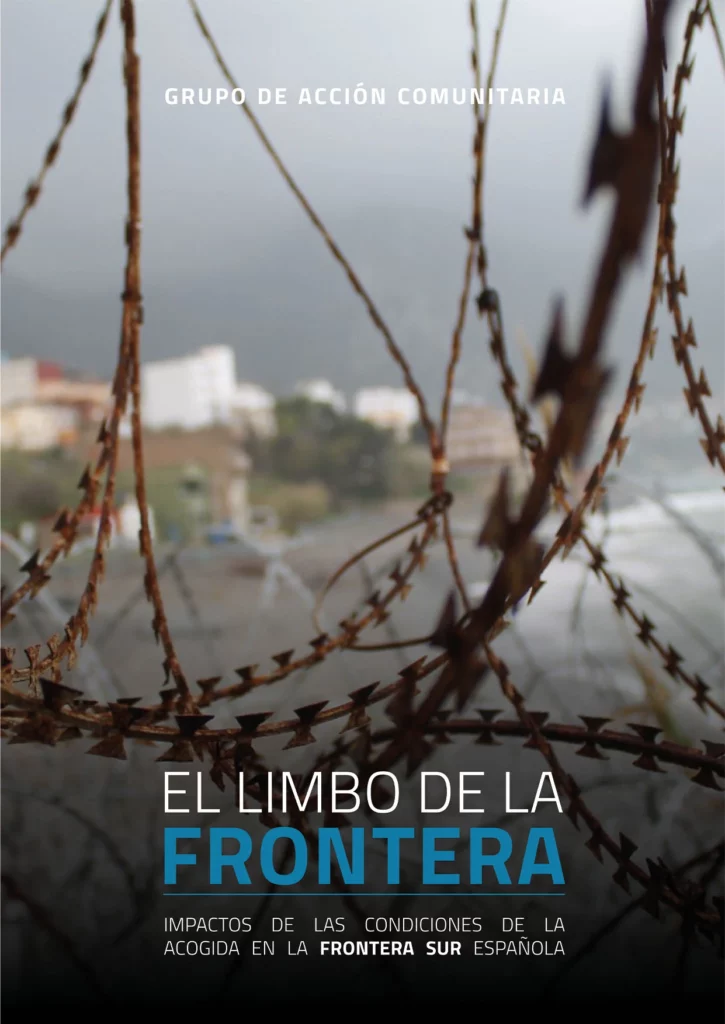

“The border limbo”, a report prepared by the GAC and Sir[a] Centre, concludes that the reception conditions in the Canary Islands and Melilla threaten the psychological integrity of migrants who arrive at their facilities
The conditions of the reception facilities on Spain's southern border present enormous deficiencies that directly impact the integrity of migrants: they cause fear, distress, and attack their dignity e identity. This is one of the conclusions of the report “The Limbo of the Border”, prepared by the Community Action Group (CAG) and the Center for Attention to Victims of Mistreatment and Torture, Sir[a]. This document analyzes the situation of people receiving care in different reception facilities distributed in Melilla and the Canary Islands, and measures the impact that these have in their psychological suffering.
The report determines that there are enormous deficiencies within the shelters. People report receiving scarce, inadequate, or undignified food; having difficulty accessing drinking water; or barely receiving enough products for personal hygiene. In general, the people living here report that they do so in conditions of overcrowding, insalubrity y lack of privacy. The text also points out that many people live with the insecurity of suffering robberies. In this context, it is very difficult for the people staying there to get restful sleep.
Beyond the material conditions, the reception process immerses people in a total uncertainty. The report highlights how a high percentage of respondents stated they were unfamiliar with the operating rules of the center receiving them, either because the rules were unclear, because they were not explained in their native language, or because their application was arbitrary. Adding to this uncertainty is the fact that people receive very little information about what will happen to them: they don't know when they will be discharged, and they are subjected to protocols and regulations. changing of which are not informed, and receive little guidance from reception services on how to regularize their status. Of all those surveyed in Melilla and the Canary Islands, only half had a lawyer to prepare for their international protection interview.
The testimony of the informants
“
They dream, or rather, they cling to the thought that they'll be released tomorrow or next week. And sometimes it can be a year or more. It's their way of surviving the situation… This drains a lot of their hope and energy into something they have no control over. Regardless of what they do or what they're going to do, it's not in their hands. The administration will decide.
“
The rules and control measures that prevent them from making decisions in their daily lives cause immense suffering for migrants. Having to depend on others to make decisions about their freedom... They tell me they are treated like animals, not like people... Feeling that their very existence is invalid. There is no greater violence than that. It doesn't matter if they hit you once or twice at the fence; it's the indifference.
Outside the walls of reception centers, migrants also encounter obstacles that generate significant psychological suffering. According to the report, those interviewed reported experiencing humiliation and dehumanization at the hands of both institutions and state security forces. In Melilla, 26.41% of respondents reported experiencing discrimination from the police or staff at the Temporary Immigrant Detention Center (CETI). In this regard, the informants consulted stated that migrants are often denied assistance by institutions or social services unless accompanied by members of civil society organizations or other entities.
The report identifies similar situations of dehumanisation. An informant claims that reception center staff were prohibited from contacting service users outside the center's premises to prevent them from empathizing with them. Similarly, the document includes testimony stating that new arrivals are often given the exact same clothes: “They tell me, how are they going to find work if they're 'dressed in migrant clothes'? They feel invisible and stigmatized both".
“The Border Limbo” bears witness to how the reception process envelops migrants in a constant feeling of being mistreated, of vulnerability and uncertainty. All of these impacts generate significant psychological suffering and trigger emotions such as fear, anxiety, and uncertainty. rage, the despair and the lack of control, knowing they are incapable of directing their own lives. In this sense, a third of those interviewed reported having considered suicide at some point as a way to end the situation. Of the total, 71% in the Canary Islands and 11% in Melilla affirmed having recurring and persistent thoughts of self-harm or suicide.
In Melilla
- 35.8% feels fear regularly
- The 30,2% frequently experiences feelings of anger
- Nearly one 50% feels apathy, discouragement, and difficulty finding sources of motivation
- A 11% presents recurrent and sustained ideas of self-harm or suicide.
In the Canary Islands
- The 71.9% shows a lack of motivation
- The 35.1% claims to feel fear
- The 42,1% usually experiences rage
- A 45, 6% argues that the conditions in the reception facilities are determining factors in their being worse off.
- A 7% presents recurrent and sustained ideas of self-harm or suicide.
Rekindling trauma on the Southern Border
Many of the people who enter Spanish territory do so with a psychological impact derived from the violence suffered in their country of origin and/or during their migratory journey. These include situations of discrimination, slavery, labour exploitation or ill-treatment and torture, among others. Specifically, the report indicates that among the people interviewed, 61.7% in Melilla and 10.5% in the Canary Islands had suffered acts of torture during their process of flight or transit. Moreover, half of the persons interviewed in the Canary Islands had some kind of vulnerability or illness, while in Melilla, 70.2% of the total did so.
These data are particularly relevant, as they point to the obligation of the Spanish State to guarantee the rehabilitation of the affected persons. Spain is a signatory to the Convention against Torture and Other Cruel, Inhuman and Degrading Treatment or Punishment (CAT) and, therefore, has the obligation to guarantee reparation and rehabilitation for those persons who require it, regardless of whether the acts of torture or ill-treatment have taken place inside or outside the Spanish State. Taking into account the deficient reception conditions, it is clear that this obligation is not fulfilled.
About the report
The report was based on 110 semi-structured interviews with the migrant population housed in different reception facilities. In Melilla, the Centro de Estancia Temporal de Inmigrantes (CETI) and a temporary shelter located in the Plaza de Toros. In the Canary Islands, interviews were conducted with people living in different recently implemented camps: “Las Raíces”, “Las Canteras” and “Canarias -50”. In addition, the report also made use of in-depth interviews with key informants from civil society.
The Centre's experience
“The Limbo of the Border” is part of a series of research projects carried out by the Community Action Group (CAG) in places of immigration detention, with the aim of measuring their impact on people. In 2017, a line of work was initiated in Mexico's migrant holding centres, and the report “Torture architecture in Europe”The study of the conditions in the former refugee camp of Moria in Lesvos shows that in both cases such contexts can be considered torturous environments.
The limbo of the border: impacts of reception conditions on the Spanish Southern Border
Reception conditions in Frontera Sur aggravate the psychological suffering of migrants arriving in Spain. We analyse the impact of reception conditions. We identify fear, anguish and attacks on their dignity and identity.