
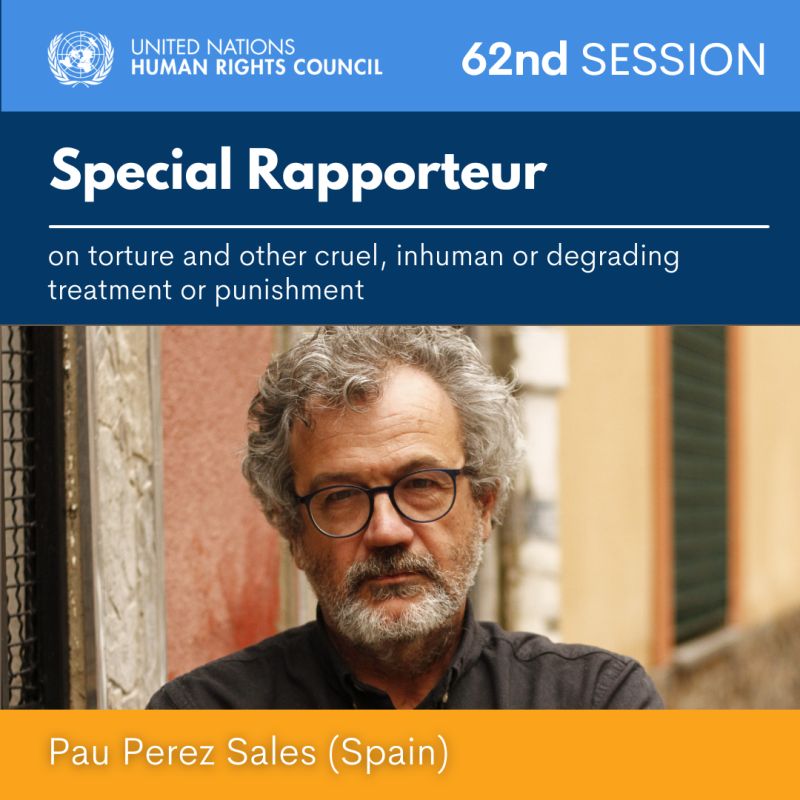
The United Nations Human Rights Council today approved the appointment of Catalan psychiatrist Pau Pérez Sales as the new Special Rapporteur on torture and other cruel, inhuman or degrading treatment or punishment.
The Special Rapporteur on torture is part of the Special Procedures of the Human Rights Council, the principal independent system of United Nations experts for the promotion and protection of human rights. Those who hold these mandates act in their personal capacity, with full independence and impartiality.
As Special Rapporteur, Pau Pérez Sales will be responsible for examining the situation of torture and other ill-treatment around the world; conducting official visits to countries; maintaining a permanent dialogue with States, national human rights institutions and civil society organizations; receiving information on alleged human rights violations; formulating recommendations and submitting reports to the Human Rights Council and the United Nations General Assembly.
On the occasion of his appointment, Pau Pérez Sales stated:
“My aim is to transform the voice of suffering and the dignity of survivors into standards, indicators, and assessment tools that incorporate medical and psychological perspectives into traditionally legally focused approaches. All of this will be done through an evidence-based approach that provides objective criteria in contexts of polarized discourse and contributes to making the victims' right to justice and rehabilitation effective.”
Pau Pérez Sales, a psychiatrist, psychotherapist, and researcher, has dedicated over three decades to intensive clinical, scientific, and teaching work in the field of trauma, torture, and organized violence. He has supported torture survivors in numerous countries and collaborated with international organizations, universities, and human rights organizations on research, training, and technical assistance.
He is a leading international authority on the study of psychological torture and torturous environments, a conceptual framework he has helped develop to understand how certain contexts, conditions, and practices can constitute mechanisms of torture or ill-treatment. He is the author of numerous scientific publications and reference works such as Psychological Torture: Definition, Evaluation and Measurement and, more recently, Torturing Environments: Psychological, Clinical and Legal Dimensions (Routledge, 2026).
He has been part of the international steering committee of the Méndez Principles on Effective Investigative Interviews, is editor-in-chief of Torture Journal and has been actively involved in the development, application and dissemination of international standards for the effective investigation and documentation of torture, including the Istanbul Protocol.
The Sira Center, an organization specializing in comprehensive care for survivors of torture and other serious human rights violations, welcomes this appointment and emphasizes that it represents recognition of a professional career dedicated to defending human dignity, preventing torture, and rehabilitating victims. The organization also notes that the mandate of Special Rapporteur is exercised exclusively in a personal capacity and with complete independence, in accordance with United Nations standards.
What does the Special Rapporteur on torture do?
The Special Rapporteur on torture is an independent expert appointed by the Human Rights Council to promote the eradication of torture and other cruel, inhuman or degrading treatment or punishment worldwide. His functions include:
- to make official visits to States and places of deprivation of liberty;
- to receive and examine complaints of alleged human rights violations;
- maintain communications with governments and make urgent appeals when there are risks of torture;
- prepare thematic and country reports;
- formulate recommendations to strengthen prevention, accountability and reparation for victims.
Are you a media outlet and want to know more?
Write to us at sira@centrosira.org