
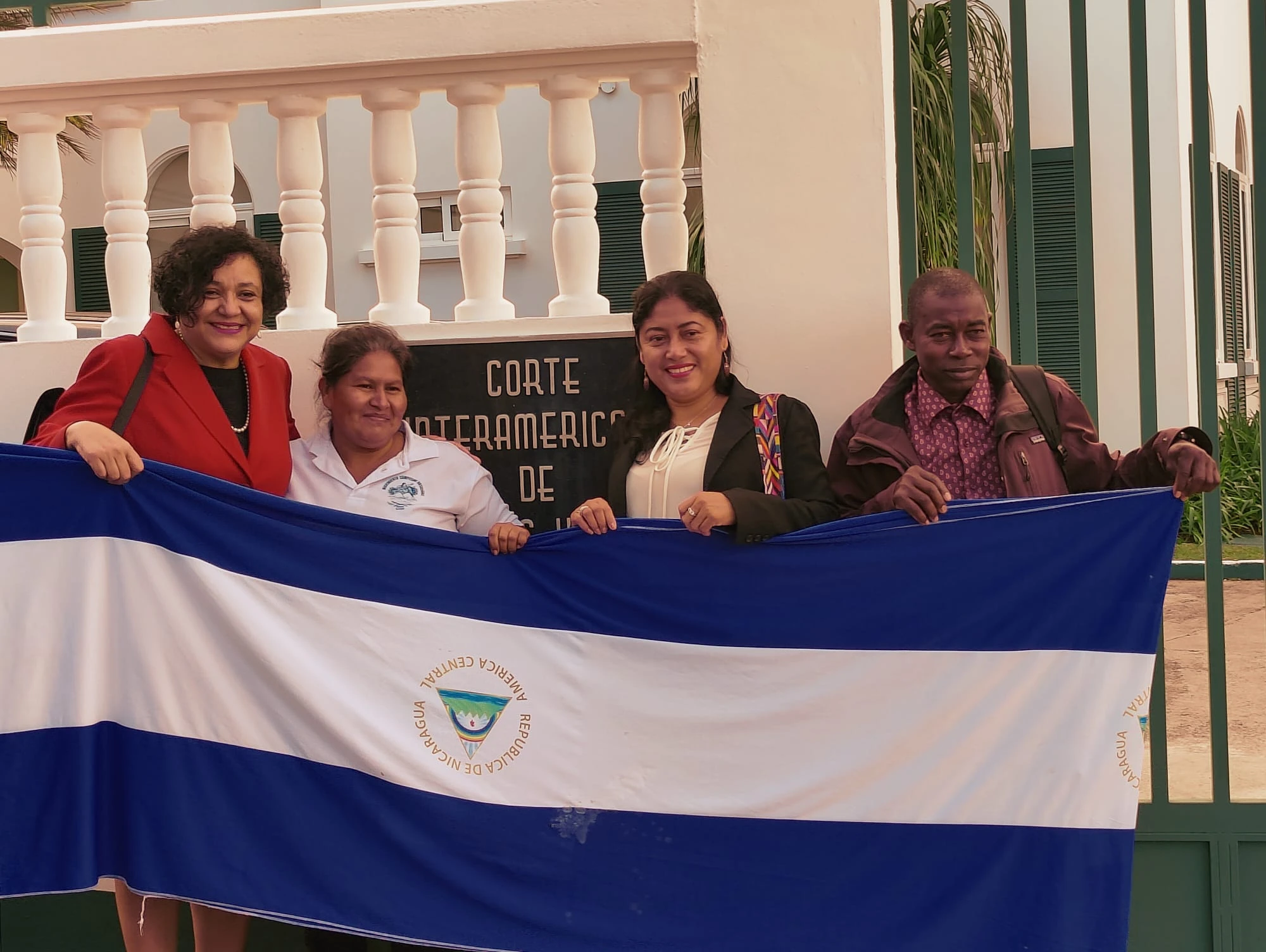
The Rama and Kriol peoples, the Monkey Point Community and the Black Creole Indigenous Community of Bluefields accuse Nicaragua of violating their rights by granting the concession for the «Grand Interoceanic Canal» mega-project, which crosses their lands.
On Thursday 2 February last, the clinical director of the Sira, Pau Pérez Sales, served as an expert witness for the indigenous and Afro-descendant communities before the Inter-American Court of Human Rights, in Costa Rica. The communities accuse the state of violating their right to self-determination, communal property and a healthy environment, due to the construction of the «Grand Inter-American Canal» that crosses their lands and whose construction was approved in 2013.
Both the Rama and Kriol indigenous people, as well as the Black Creole Indigenous Community of Bluefields, claim to have been excluded from participating in the decision-making process of this project, despite the fact that the 52% of the Canal route crosses their territories. According to the plaintiffs, the implementation of this megaproject would force many of their communities to be forcibly displaced from their territories, renouncing their customs and traditions, which are closely linked to their land.
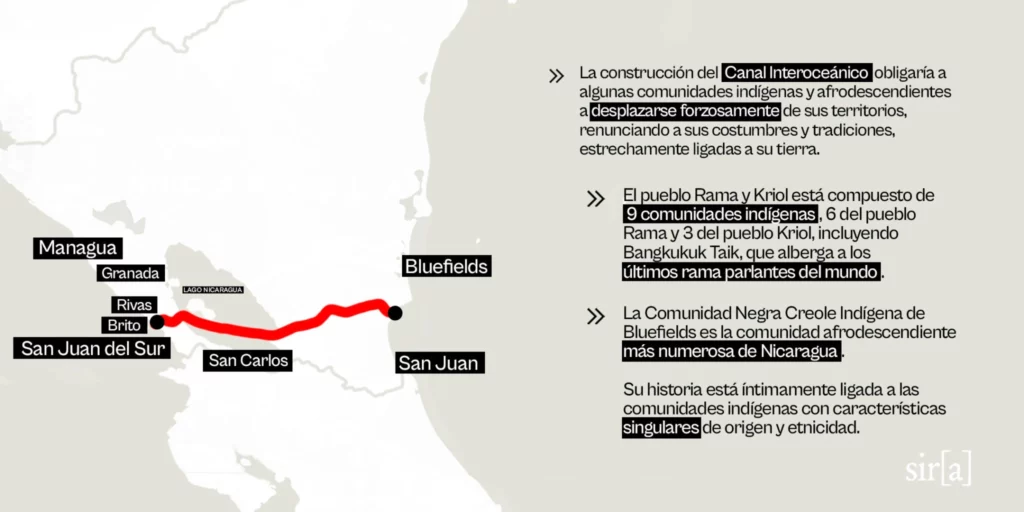
The red colour indicates the route of the Interoceanic Canal, which occupies up to 52% of the applicants' territory. Sir[a] Centre
Continued attacks
The communities accuse the government of having carried out various attacks against them over the years through the militarisation of the territory, the destruction of their heritage and economic suffocation, with the aim of mitigating or undermining their resistance to the project. At the Sir[a] Centre, in our work as experts, we have confirmed and documented these actions, to the point of concluding that the Nicaraguan state has intentionally set up a Torturing Environment on the lands of the affected indigenous and Afro-descendant communities, The aim was to break the resistance against the Grand Interoceanic Canal project.
The Nicaraguan State is said to have recurrently carried out a series of actions which, as a whole, generate such great suffering in people that, according to international law, they fall within the definition of torture.
As experts, based on a literature review and interviews with community leaders, we have identified different mechanisms aimed at mitigating resistance to the Interoceanic Canal. These include the progressive militarisation of the territory; the continued presence of armed settlers or paramilitary groups in the area; institutional neglect; the destruction of the intangible heritage of the Rama and Creole people, as well as their natural habitat (massive logging, fires, etc.); the control of the media; and the intimidation, blackmail, monitoring, threats and continuous harassment of community leaders.
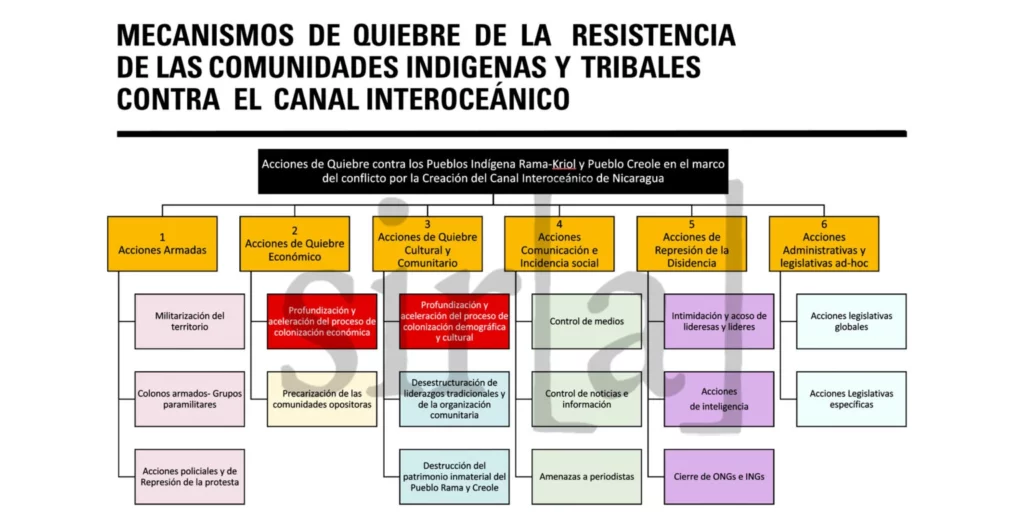
Diagram of state actions aimed at breaking community resistance. Sir[a] Centre
Breakthrough actions
In addition to the destruction of the territory, all of these actions result in forced displacement, polarisation of the population, a generalised and internalised feeling of anguish, fear and terror, as well as a breakdown of trust in the state and its judicial bodies. Likewise, these actions cause the population to weaken a vital muscle for the survival of their traditions, such as a loss of identity roots, the breakdown of cohesion and leadership systems or family systems of mutual support. On the other hand, from a clinical point of view, the people who have been assessed present post-traumatic stress disorders, traumatic damage to identity and perception of the world, and symptoms of anxiety and depression, among others.
With all this evidence, the clinical director of the Sir[a] Centre, Pau Pérez Sales, defended before the Inter-American Court of Human Rights As from the work carried out during the last months, we can conclude that there is indeed a map of actions undertaken by the State with the objective of breaking the resistance to the Canal project. In this sense, based on the psychosocial, community and individual suffering of the victims, we can verify that there is an intentionality on the part of the state and, therefore, it can be concluded that there are sufficient conditions to consider that its actions constitute a "state action". Torturing Environment.
Nearly 10 years demanding the cessation of the project
The origin of the events dates back to 2013, with the approval of the «.«Law 840«The canal is declared to be of supreme national interest and a concession is granted to HK Nicaragua Development Investment. The construction of the canal is declared of supreme national interest and the concession is granted to the company HK Nicaragua Canal Development Investment. A year later, the government announced that the route of the Interoceanic Canal would pass through the Rama and Kriol territory, which is made up of up to 9 communities in the southeast of Nicaragua. Since then, these communities have publicly resisted the construction of the canal, both through social mobilisations and through legal means, to the point of filing up to 19 appeals for legal protection (recursos de amparo). All of them have been rejected by the Nicaraguan judicial system.
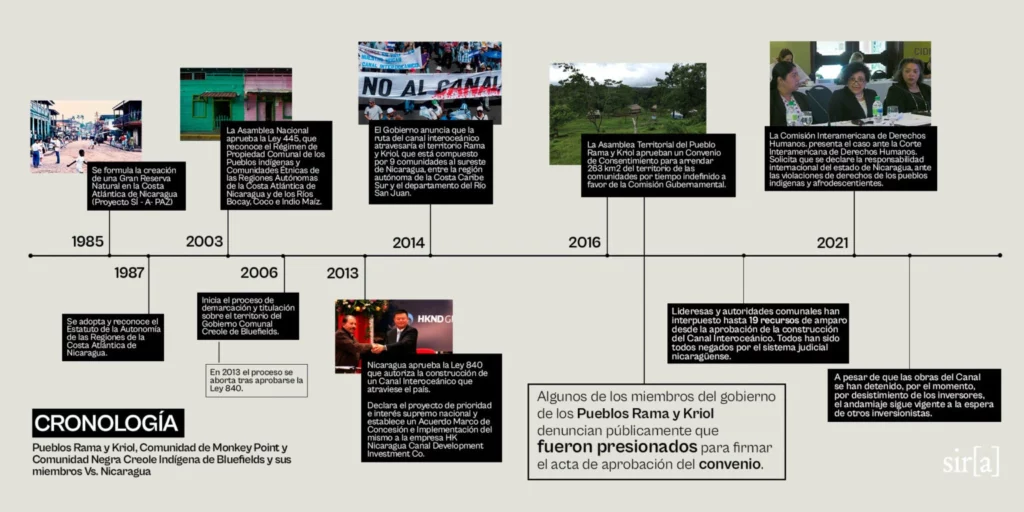
Chronology of the case between the claimant communities and Nicaragua. Sir[a] Centre
Torturing environments
Traditionally, torture has been measured and studied exclusively as a method. However, this approach is limiting, as it does not take into account the infinite forms of torture that perpetrators“ imaginations can produce, nor their methods, or the individual and subjective experience of victims. The term "Torturing environments”seeks to overcome precisely this pitfall. It is a concept that does not analyse torture by focusing only on the methods, but also concentrates on the context in which it is exercised. That is to say, the “environment”.
We understand a Torturing Environment as a space in which conditions are created that, taken together, would meet the definition of torture. It is a total of contextual elements, conditions and practices, which diminish or override the victim's will and control over his or her life, and which compromise the “self”.
This concept understands that torture is not due to a single technique, but depends on a cumulative effect or on the combination of various methods of torture which, when used in line with each other, would not produce the same effects.
Intentionally, this group of elements, strategies and methods seeks to intimidate, coerce or bend the will of individuals or communities to the desires of the creator. It seeks to physically, cognitively, emotionally or sensorially assault the victim by attacking the core elements of his or her identity or those of his or her group.