
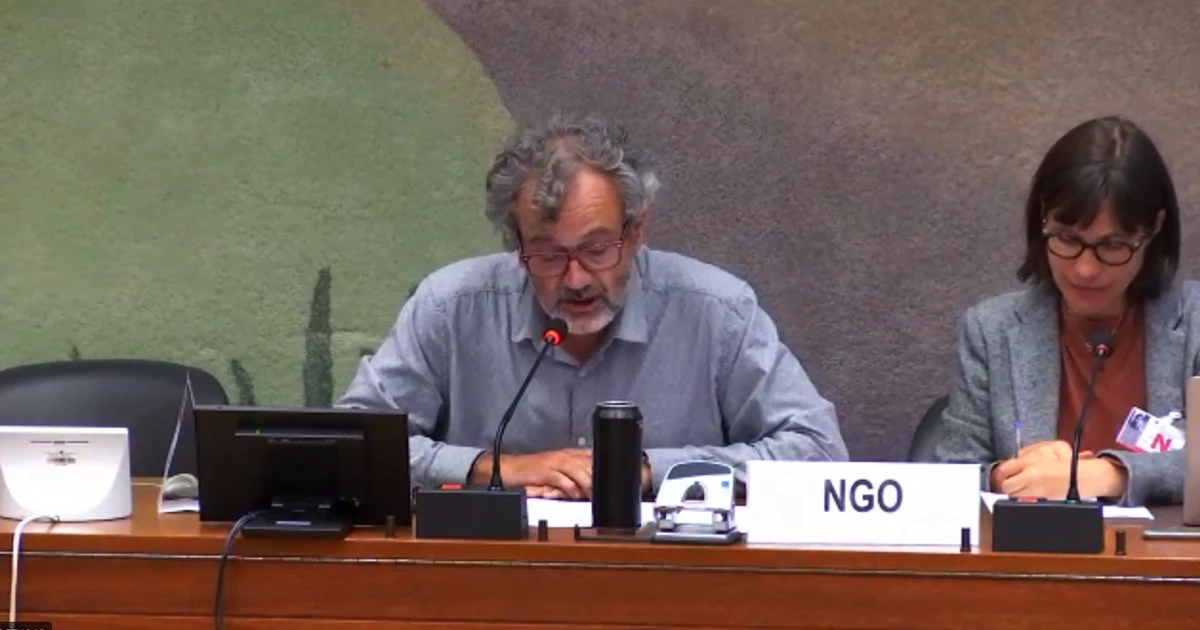
The clinical director of the Sir[a] Centre presented to the UN Working Group on Enforced or Involuntary Disappearances the special issue of the Torture Journal, focusing on the consideration of enforced disappearance as torture.
Together with Helena Solà Martín, Senior Legal Policy Adviser of the World Organisation Against Torture (OMCT) and Bernand Duhaime, Professor of International Law at the University of Quebec, Pau Pérez Sales, as editor-in-chief, presented in Geneva the special issue of Torture Journal, published by the International Rehabilitation Council for Torture Victims (IRCT), before the UN Working Group on Enforced or Involuntary Disappearances.
In the session, the speakers reviewed some of the contents of the issue - including articles focusing on cases of disappearances in Chile, Colombia, El Salvador and Algeria, among others - and emphasised the need to conceptualise the issue in terms of its content. enforced disappearance as a form of torture. The research team argued to the members of the Group that this kind of crimes, such as abduction, arrest, detention or other forms of deprivation of liberty, generate suffering and impact that not only affects the direct victim, but also inflicts permanent pain on the relatives, which should be recognised as a form of torture.
The work identifies enormous levels of anguish and suffering among the relatives of victims of enforced disappearance, as well as long-lasting impacts such as depression, post-traumatic symptoms or the rupture of their worldview. All consequences from which to argue that enforced disappearance is not only a form of torture for relatives, but also that addressing it must be treated as a priority. On this consideration depends the guarantee of carrying out reparation processes that are adequate and fair for all affected parties, including the recognition of the pain and anguish of the victims' relatives.
About the WGEID
The work of the UN Working Group on Enforced or Involuntary Disappearances (WGEID) acts as a channel of communication between relatives of victims of enforced disappearances and governments or other sources reporting cases of disappearances. It is a group composed of five independent experts, selected on a principle of geographical distribution. The Group investigates individual cases and prepares reports and opinions.
Pau Pérez Sales and Helena Solà during the session of the UN Working Group on Enforced or Involuntary Disappearances in Geneva.