
ElDiario.es reveals a police protocol for border agents that not only criminalizes people on the move, but also makes potential victims of torture and ill-treatment invisible.
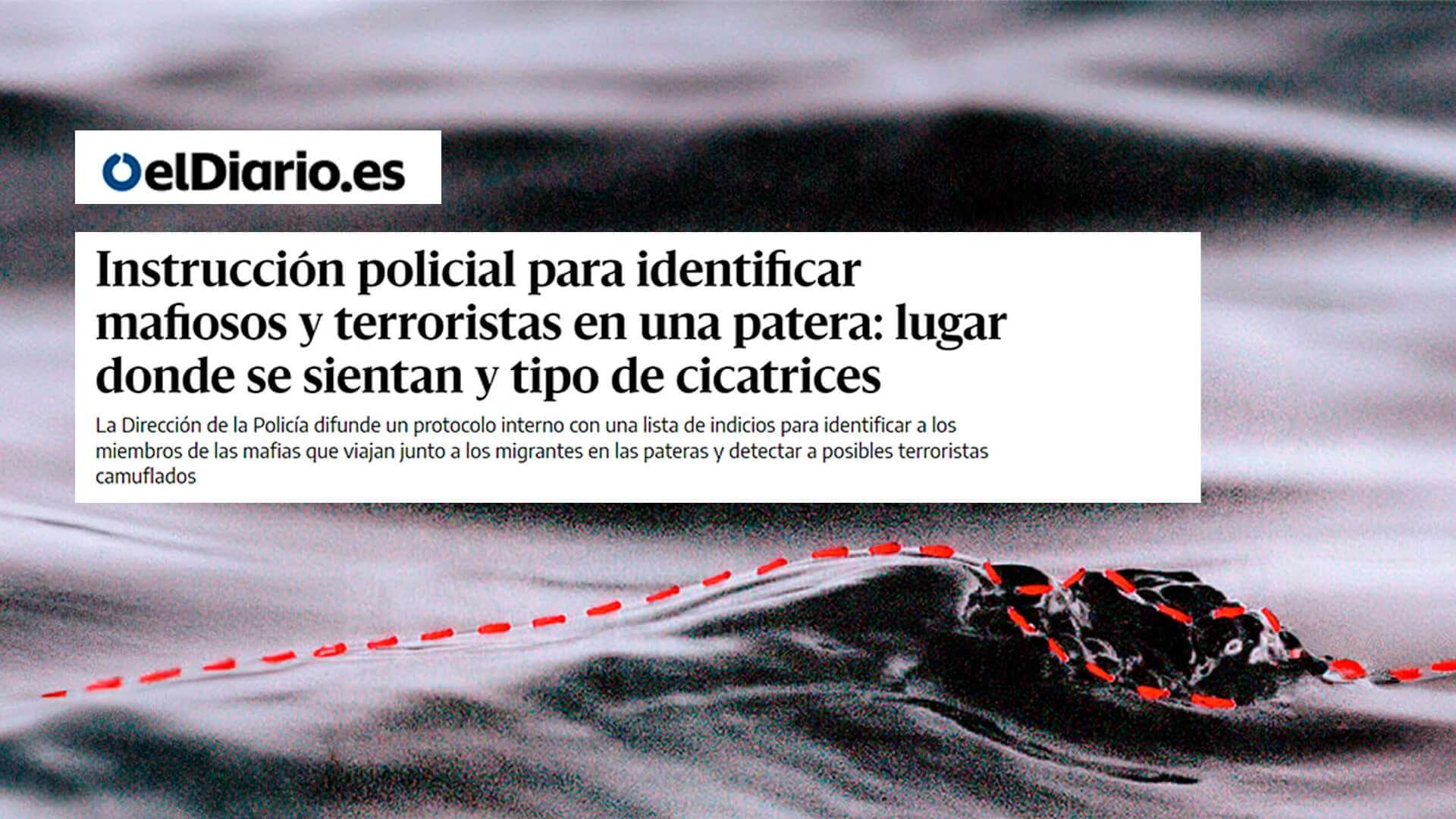
On May 7, elDiario.es published an article in which it describes the guidelines that the General Directorate of Police The protocol has been disseminated among its agents at the border to "identify members of the criminal networks traveling with migrants in small boats and detect possible terrorists in disguise." The protocol includes a series of indicators that, according to authorities, would help identify members of these networks. mafia networks: sitting close to the boat's engines; appearing to be guarding the group's food, water, or fuel; or displaying an attitude of leadership, instead of a behavior vulnerable, among others.
Regarding the identification of potential members of violent groups, The protocol also establishes a list of indicators: that the person has suffered the amputation of one of its members, who presents bruises or wounds of a bladed weapon or a bullet, or that has a high number of scars on his body. All of them would be indicative to the police that they are dealing with a possible terrorist.
As an organization with a long history of providing comprehensive support to Migrant survivors of torture, We understand that this Protocol not only implies a criminalisation of people on the move, but also makes invisible to potential victims of torture and ill-treatment.
First of all, The instruction overlooks the possibility that those occupying the apparent “command positions” may be people forced into them by the very networks that organize the journey and remain on land. report from United Nations It clarifies that boat operators are rarely associated with organized crime groups and that, if they are, they are very low-level actors. During 2023, the Center for the Defense of Human Rights, Iridia, identified at least 4 children in pretrial detention accused of human trafficking.
On the other hand, in our experience as Centre for the Care of Victims of Ill-treatment and Torture, We don't understand how the location and shape of the physical aftereffects From people in motion, to clues for identifying potential members of violent groups. The size, color, location, shape, or account of the origin of physical wounds are precisely indicators which often warn us that we are facing a victim of torture. In the case of people new arrivals, They could also serve as a sign that the person needs therapeutic and clinical assistance. urgent. By focusing on the physical consequences, this Protocol puts at risk and makes potential victims invisible.
In many cases, survivors of torture present physical injuries as a result of the torture they have suffered both in their countries of origin and in transit countries. Those who undertake their migratory journey from Africa towards Spain, In a very significant number of cases, they face systematic violence that leaves indelible marks on the body, and which include extreme physical assaults, labor exploitation, extreme poverty, kidnappings, or sexual violence. In our report “Labyrinths of Torture”, we examined the physical and psychological impacts of this violence and determined that the 97,7% of the cases analyzed suffered physical aggression.
The violence suffered in traffic generates a physical and psychological impact on many occasions permanent or intractable. How much harm can be done to a torture victim, who is escaping a life-threatening situation, if they are also accused of belonging to a violent group?
”"Border officials can play a key role in the early identification of victims of ill-treatment and torture, as well as in the implementation of a referral process that offers them care, safety, and prevents re-victimization.".
As human rights organizations working in Frontera have been denouncing for years, the only effective way to prevent deaths and combat human trafficking is to guarantee safe and legal pathways for people on the move. According to the group, Walking Frontiers, 6,618 people They lost their lives on the Western Euro-African Border on their way to Spain. Meanwhile, Association for Human Rights of Andalusia (APDHA) It was estimated that in 2023, up to 2,789 people They lost their lives or disappeared on the Southern Border trying to reach Spanish territory.
Far from working for the securitization and criminalization In a similar scenario, regarding borders, the State may redirect its efforts towards respecting the fundamental rights of newly arrived people, especially at the border. This includes ensuring access to legal assistance and an interpreter in case of arrest, as well as guaranteeing dignified reception conditions. The lack of information, the dehumanisation and the overcrowded conditions that people suffer in the Reception Centers, do nothing more than to revive previous impacts that people suffer.
Regarding survivors of torture, it cannot be overlooked that border officials can play a key role in the early identification of these profiles, as well as in implementing a referral process that offers them care, safety, and prevents revictimization. To achieve this, border agents should receive comprehensive training on the risks and consequences of torture, the early warning signs, as well as on the responsibilities of States with respect to victims of torture.
Spain, as a signatory to the United Nations Convention against Torture and Ill-Treatment, has an obligation to guarantee the right to rehabilitation. It is its responsibility to ensure that migrant survivors of torture are identified as soon as possible through appropriate examination, in accordance with the Manual for the Effective Investigation and Documentation of Torture and Other Cruel, Inhuman or Degrading Treatment or Punishment., Istanbul Protocol.