
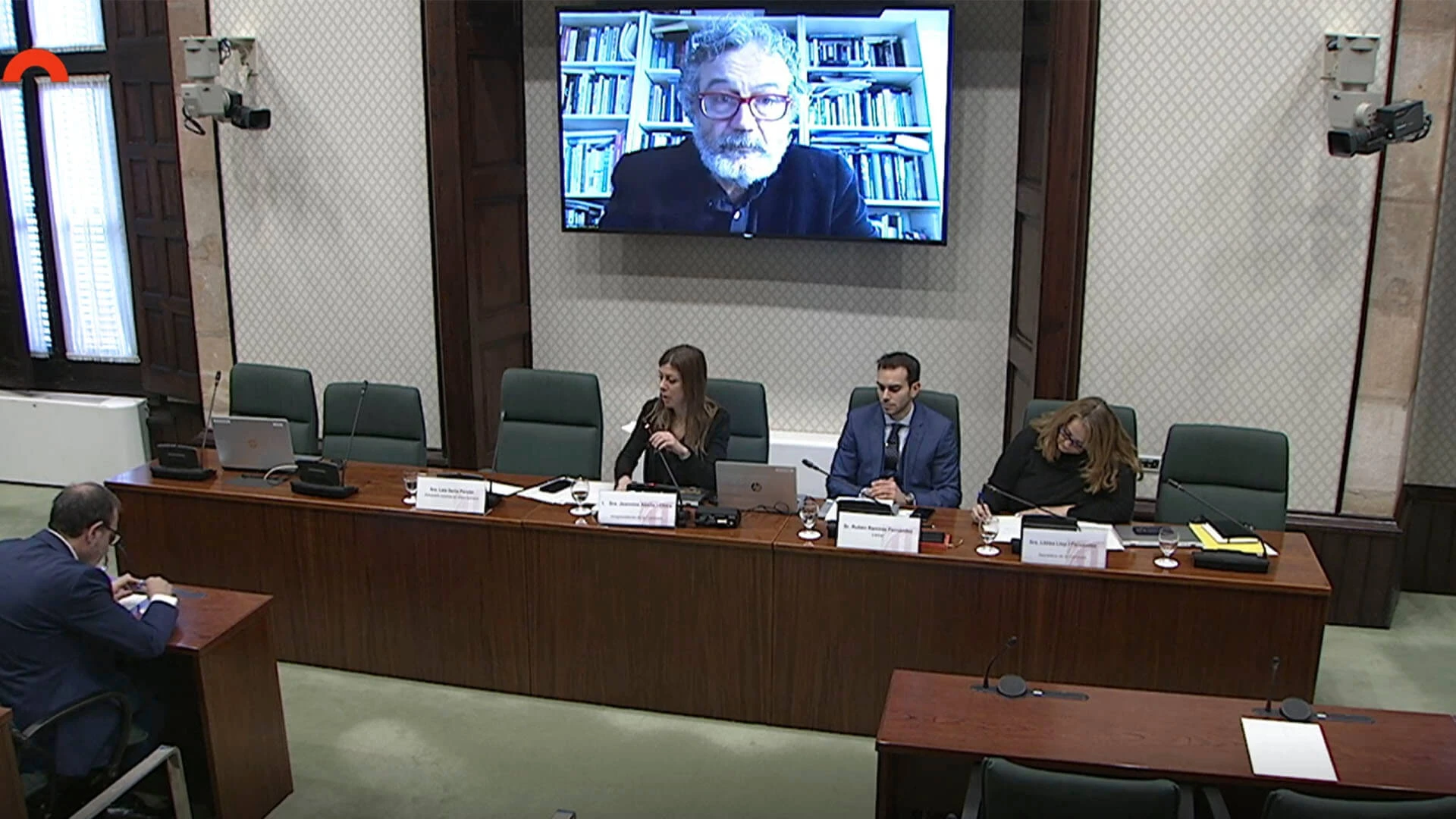
After having accompanied and assessed practically all of the people affected, Pau Pérez Sales, on behalf of the organisation, explains the nature of the damages
70% of the women tested had suicidal thoughts after discovering the infiltrations.
Pau Pérez Sales appeared on Thursday 15 February before the “Investigative Committee on the Infiltration of State Police Cossos Policies in the Social, Political and Popular Movements of the Country's Arreu”, of the Parliament of Catalonia. The clinical director of the Sira Centre, in his capacity as an expert, presented some of the impacts encountered after assessing virtually all persons directly affected by police infiltrations from all over the state, through the Istanbul Protocol. Activists in various social and popular movements - mostly women - who had established militant, friendly and sex-affective relationships with undercover police officers, who sought to obtain privileged information.
Since these actions were uncovered by media,The Sira Centre has accompanied almost all of those affected and provided various expert reports as tools for their defence.
Clinical impacts
Among the most serious psychological impacts, In the case of the latter, depressive episodes, anguish crises or insomnia stand out. Of the total number of people assessed, 70% claims to have had suicidal thoughts at some point.. In 90% of the cases, these ideas are linked to shame, humiliation suffered or a clear idea of “irreversibility of the damage”. Victims also report problems of rejection or discomfort with their body and/or episodes of bulimia or anorexia. Between 72 and 85% consider themselves to have suffered from a loss of self-esteem, as well as a severe deterioration of their self-image. In 40 % of those evaluated, obsessive behaviours were also identified, such as the need to clean or reorganise spaces shared with the infiltrators, such as the home or bedroom, because they consider them to be contaminated places.
”Guilt for the relationships he has maintained because of me... and for opening the possibility for him to enter other spaces and have other intimate relationships...”.”
The majority of the expert witnesses present experiences of guilt and attribution of responsibility for what happened to themselves, something that is common in the context of sexual assaults. “Guilt for the relationships that he has maintained thanks to me... and for opening up the possibility for him to enter other spaces and have other intimate relationships...”, says one of the women interviewed.
Throughout his appearance, Perez also pointed out that in addition to the experiences of guilt, there are a series of ontological impacts, The police have been able to find out from the interviewees how they could have used something as intimate as emotional relationships to obtain information. Of the interviewees, three of them fail to understand how the police could resort to something as intimate as emotional relationships in order to obtain information. It was clearly unnecessary harm... why did he do it? Why did he do gratuitous harm to me that made no sense in what he was supposed to do,“ says one of them.
Consequences of infiltration
In many of the cases, the impacts of the infiltrations had direct repercussions on the different spheres of life of the persons surveyed. Some of them suffered a significant decrease in their academic performance - The respondents had difficulties in continuing to work as a result of ruminations and distress, while others experienced difficulties in continuing to work. Of the total number of respondents, 4 had to apply for a sick leave.
The vast majority of people are now wary of telephone use, have the feeling of being watched, They are hesitant to use email or private messaging networks. Pérez also pointed out in the hearing that there is a fear among the victims that they could be unjustly inculpate in the future. In some cases, the interviewees claim that items of clothing or hygiene items have gone missing, indicating that biological samples may have been taken during the encounters, which they fear could be used to “build a case” for them in the future.
Since the cases of police infiltration were uncovered, virtually all of the people who have been involved in the decreased its participation in social and militant spaces, for not considering them as SAFE PLACES. This is particularly traumatic, bearing in mind that militancy has always been an essential part of the identity of the examinees.
”With this person who does not exist, there was consent. But as he does not exist, I did not give consent, and if I had given consent, it would have been to a person who does not exist. Consent to a being that does not exist. There is no consent.»
Feelings of humiliation
Almost all of the female experts claim to have considerably reduced their sporadic affective relationships as a result of the infiltrations. There is a general feeling of humiliation and a direct attack on their dignity. “They have used your understanding of sex, love and emotions against you, says one of the experts.
The total amount is that there was deliberate deception on the part of the police officers and they were deprived of their ability to choose freely,They were unaware of the identity of the subject and the purpose for which sex-affective relations were established with the victims. All persons understand that with this deception, were forced to act against their own convictions. They all claim that they would never have had sexual relations with the undercover agents, had they known who they really were. “With this person who does not exist, there was consent. But as he does not exist, I did not give consent, and if I had given consent, it would have been to a person who does not exist. Consent to a being that does not exist. There is no consent.”, says one of the expert witnesses.
Victims of torture
Among his conclusions, Pau Pérez Sales affirms in Parliament that there is a high degree of consistency between the facts alleged by individuals and their impacts. The expert opinion of the Sira Centre concludes that the people affected by police infiltration of social and popular movements throughout the state should be considered as victims of torture, and the police agents as perpetrators, since there is evidence of a conscious action - aimed at accessing information - which has had a serious psychological impact.
The persons examined have serious clinical and ontological impacts, which are a consequence of the direct action of public officials. The police followed a deliberate and consistent strategy - as can be deduced from their patterns of action throughout the State - with the clear purpose of gaining access to the victims' intimate, personal and family information, as well as to information on the operating patterns and targets of social movements perceived as “disruptive”. Taking all these elements into account, the Sira Centre's experts conclude that these events may constitute torture, according to international standards.
On the other hand, Pau Pérez Sales also points out that police infiltrations have not only individual consequences, but also collectives. From the point of view of psychosocial, In addition, social, community and popular movements throughout the country also suffer from a lack of trust, a “discouragement effect” with respect to institutional spaces and spaces for political and social participation, and a refusal to continue participating in these spaces. The expert from the Sira Centre concludes that, through these actions, the state is sending out a warning message: popular social movements are considered “philo-terrorist groups”, which makes them the object of surveillance.