
The judge took the testimony of the complainant and the witness Rosa María García Alcón on 15 September 2023, which was an exceptional event as it was the first time that victims of Franco's regime had testified in Spanish courts.
The Law of Democratic Memory passed in 2022 is still insufficient to put an end to impunity for the crimes of Francoism. All the complaints filed after the entry into force of this law have been inadmissible and/or archived.
The memorial and human rights organisations will continue to fight to break the wall of impunity and to investigate and prosecute the crimes against humanity committed during Franco's regime.
On 12 May 2023, the Judge of the 50th Preliminary Examining Court of Madrid, Ana María Iguácel Pérez, admitted for processing the criminal complaint filed by Julio Pacheco in which he denounced the torture he suffered, in a context of crimes against humanity, in August 1975. Months later, he took statements from the complainant himself and a witness, Rosa María García Alcón.
After 6 years of struggle in the Spanish courts and more than 100 criminal complaints filed denouncing crimes against humanity committed by Franco's dictatorship, the Julio Pacheco was the only one in which, after being admitted for processing, the defendants were summoned as investigators and statements were taken.
One year later, the same judge has proceeded to close the case due to the statute of limitations, in accordance with the content of Order 57/2024 issued by the Plenary of the Constitutional Court. In this order, the judicial channel was closed in the Spanish courts of another lawsuit for crimes of torture during the Franco dictatorship, filed by Francisco Ventura Losada.
The Constitutional Court, in the Order that has led to the case of Julio Pacheco being closed, considers that the current Law of Democratic Memory does not replace this Court in the interpretation of fundamental rights and that its articles are insufficient and do not enable it to investigate Franco's crimes.
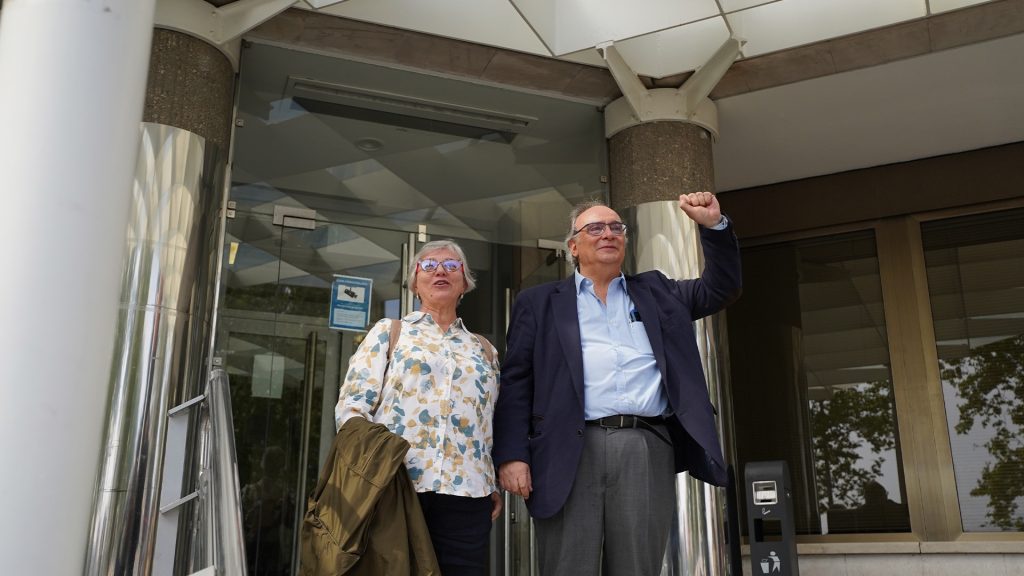
Julio Pacheco and Rosa García at the exit of the Courts. Sira Centre
In short, the Constitutional Court considers that the content of Article 2.3 of the Law of Democratic Memory, insofar as it establishes that “all the laws of the Spanish State, including Law 46/1977, of 15 October, on Amnesty, shall be interpreted and applied in accordance with conventional and customary international law and, in particular, with International Humanitarian Law, according to which war crimes, genocide and torture are considered to be imprescriptible and not amnestiable, crimes against humanity, genocide and torture are considered to be imprescriptible and not subject to amnesty”, is not sufficient for the rules of international criminal law to become a direct or indirect source of criminal law for investigating and judging acts that were not criminalised in the State criminal law in force at the time.
From CEAQUA, Amnesty International, Iridia and Sira, we express our most absolute disagreement and absolute rejection of the content of the Court Order issued by the 50th Court of Instruction of Madrid, which based on the content of the Constitutional Court Order 57/2024, consolidates a model of impunity unacceptable in a State of Law and undermines and infringes, once again, the most elementary rights of those who suffered Franco's crimes.
The corresponding appeal has been lodged with the Provincial Court of Madrid against the order issued by the 50th Preliminary Examining Court of Madrid.
In any case, there is no doubt that with the content of these rulings it is more necessary than ever that both the executive and legislative powers immediately get down to work to promote all appropriate legislative measures to reverse the impunity of Franco's crimes, as it has become clear that the Law of Democratic Memory passed in 2022 is insufficient for this purpose. With the dismissal of the case brought by Julio Pacheco, all the lawsuits filed after the entry into force of this law have been inadmissible and/or dismissed.
Responsibility for maintaining this framework of impunity is shared by all three branches of government and it is no use focusing solely and exclusively on the judiciary.
At a time when regional initiatives are being promoted in Spain that curtail the effective rights of the victims of Franco's crimes, it is necessary to give a forceful response in the form of the promotion and approval of legislative measures that enable the criminal investigation of these crimes.
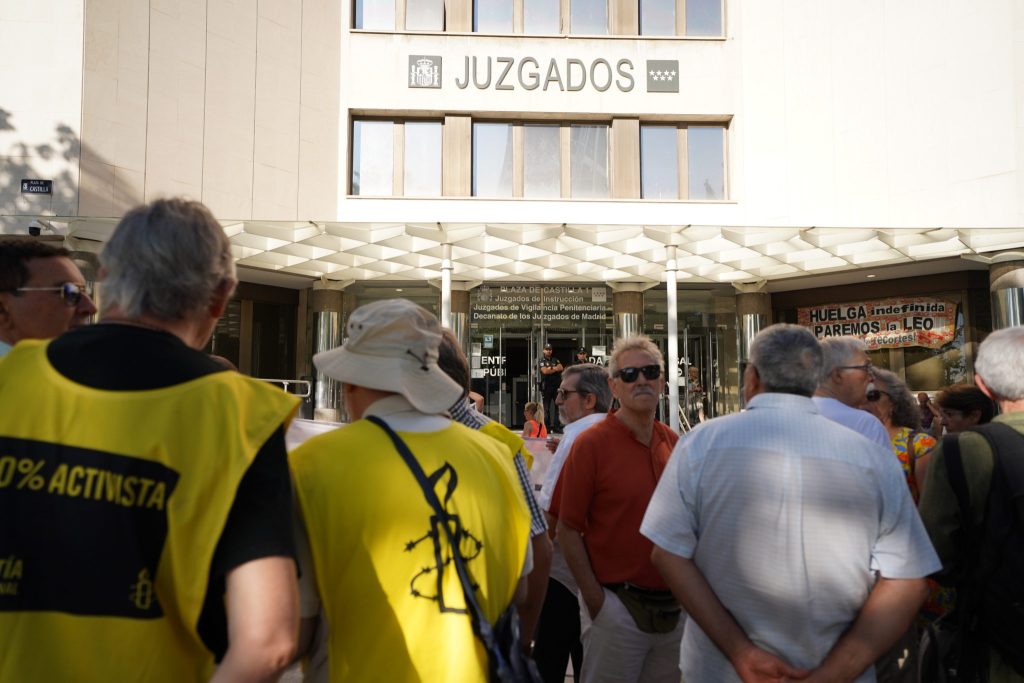
Rally in support of the plaintiffs, Julio Pacheco and Rosa García. Sira Centre
Once again, we would like to remind you that, among other things, it is essential for this:
- Repeal/amend the Amnesty Law so that international crimes cannot be amnestied.
- The introduction of the principle of legality in the Spanish Criminal Code from an international law perspective, guaranteeing that international crimes committed in Spain prior to their classification in domestic law can be investigated and prosecuted.
The reform of the Penal Code, among other aspects, of the definitions of torture and enforced disappearance from an international law perspective. These two legislative measures, promoted at the time by CEAQUA, were rejected by the legislature by a large majority. Today, more than ever, it is necessary to take them up again in order to proceed to their approval. From CEAQUA, Amnesty International, Iridia and Sira will continue to work in this direction, we will continue to demand criminal justice and we will challenge in all appropriate instances the judicial decisions handed down by the courts and tribunals of the Spanish State.