
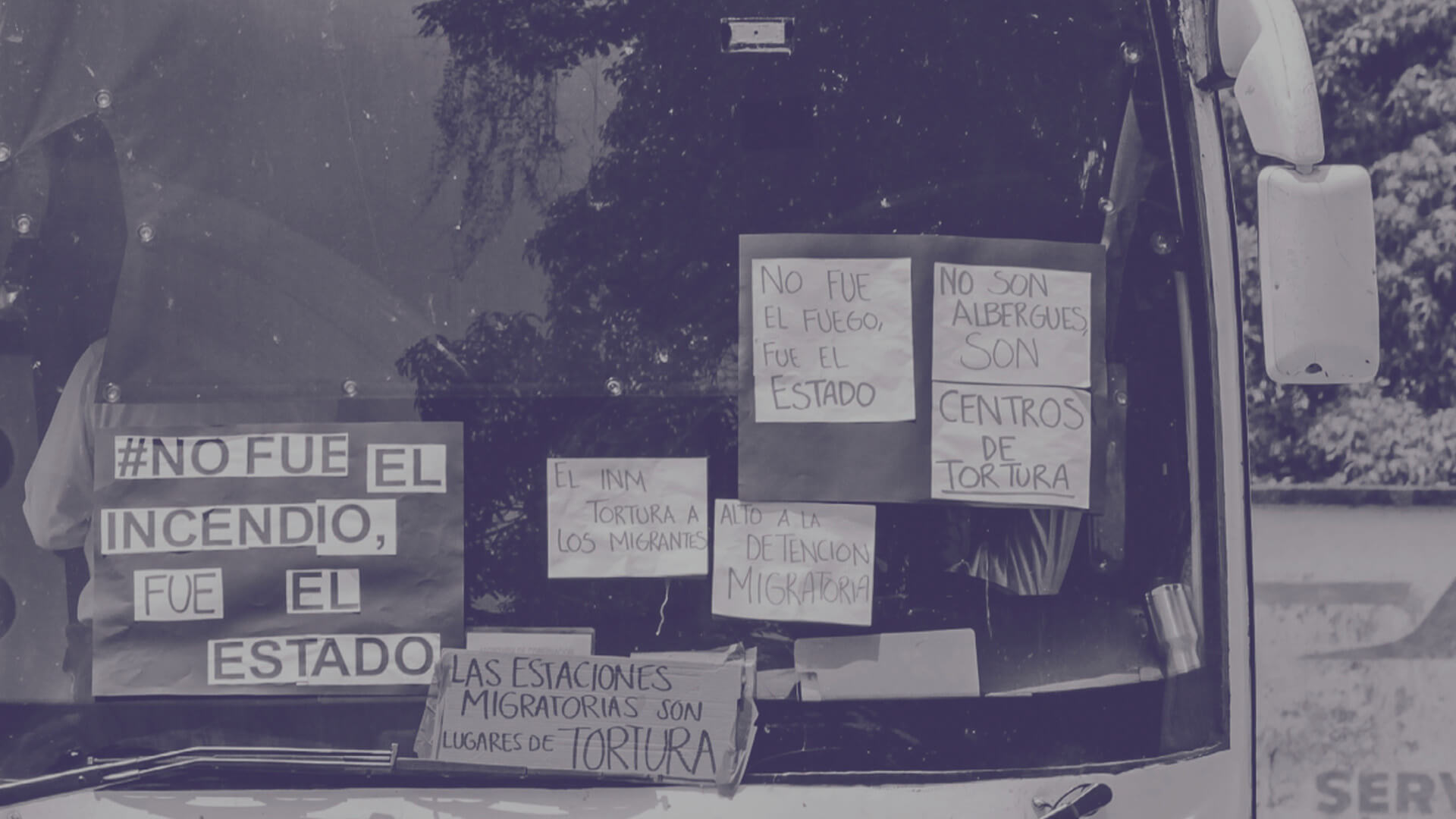
The concept of torturing environments makes it possible to name and understand violence in immigration detention centres in a broad context, and its effects on individuals.
YURIRIA SALVADOR : Advocacy Coordinator of the HRC Fray Matías de Córdova
Since 2006, the Fray Matías de Córdova Human Rights Centre observes and monitors the situation of persons deprived of their liberty for migratory reasons at the Siglo XXI Migration Station, at Tapachula, The report also refers to the fact that the migrants were held in detention centres for migrants that were not formally recognised before that.
One of the main challenges in the monitoring and accompaniment of persons in immigration detention, is to document how the range of human rights violations they often experience affect their overall health and have an impact on their host communities. The use of the euphemisms “temporary stays and immigration stations” to refer to detention centres is a first barrier to the recognition that immigration detention exists and is a fundamental pillar of migration policy in Mexico.
Until 2023, the 21st Century Migration Station regularly operated at or above capacity, so that detainees - men, women, LGBTIQA+ persons, asylum seekers - lived in overcrowded and critical climatic conditions (high temperatures and humidity). Added to this is the lack of information on regularisation or asylum procedures and/or on their rights, as well as the manipulation of the environment, exercised through having the lights on 24 hours a day, limiting the possibility to urinate or defecate and experiencing hunger or thirst, to mention just some of the documented elements reported in the report. Immigration Detention Centres as Torturous Environments, The report, produced by the Migrant Detention and Torture Advocacy Group (GIDMT), in 2023.
In addition to these conditions, CDH Fray Matías has documented physical violence, psychological violence (threats of harm to the individual or to other family members) and ill-treatment, as well as acts of individual and collective torture, In many cases, migrants have died in detention due to the lack of adequate and timely medical care.
”The impossibility of contact with the outside world, disinformation, and total control over detainees persists and takes its toll on people's lives.
The concept of torturing environments, understood as the “set of contextual elements, conditions and practices that diminish, annul or erase the will and control of the victim, compromising his or her self», allows us to name and understand the violence exercised in immigration detention centres in a broad context, and its effects on people: discrimination, fear, uncertainty, subjugation of the will, and other violence that has a cumulative effect that undermines people's autonomy and integrity.
The use of elements from the scale of torturous environments proposed by the Sira Centre and the Community Action Group The development of a methodology and tools for monitoring in immigration detention centres is extremely useful for CDH Fray Matías to generate evidence on the punitive approach that prevails in detention centres and how all of the conditions described above constitute torturous environments.
After the fire at the Ciudad Juárez Migratory Station on 27 March 2023, in which 40 people died and 27 were injured, the National Migration Institute (INM) announced a “comprehensive transformation of the XXI Century Migratory Station in Tapachula”, which, according to the authority, included the elimination of bars and padlocks, as well as the removal of 34 doors in the facilities and “the whole concept of the prison model” - according to the words of Francisco Garduño, Commissioner of the INM - and the installation of murals in different parts of the centre.
The recognition that the stations have constituted spaces of deprivation of liberty is a step towards the end of a model of migration management that compromises the life and integrity of people. However, aesthetic and infrastructural modifications are not enough to guarantee full protection for migrants, asylum seekers and refugees who are detained.
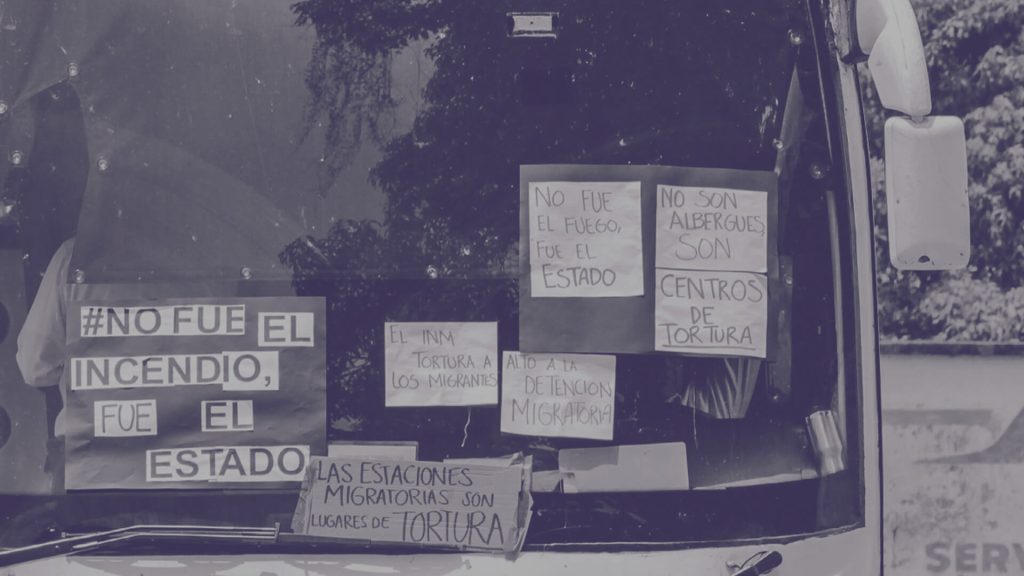
Image from the report «Immigration detention centres as torturing environments» (2024).
The impossibility of contact with the outside world, misinformation, and total control over detainees persists and takes its toll on people's lives. The steady increase in immigration detention from 2018 to date is indicative of the prioritisation of immigration control over the safety of people, while the public dissemination of detentions referred to as “rescues of persons”The "National Guard" stigmatises the migrant population and generates a narrative that legitimises systemic violence simply because they do not have a regular administrative status in Mexico.
The end of immigration detention as a possible horizon for the transition to a reception model based on respect for people's rights and which prioritises social integration, may still be a long way off. In the meantime, the organisations will continue to accompany people in detention and, above all, we will not take our finger out of the wound of the torturing conditions that persist in detention centres and that require more than a transformation of infrastructure: the definitive closure of immigration detention centres and stations, investigation, punishment and comprehensive reparation of damages for victims of human rights violations in detention, memory so that never again will a person be tortured, abused or die for exercising their right to migrate.
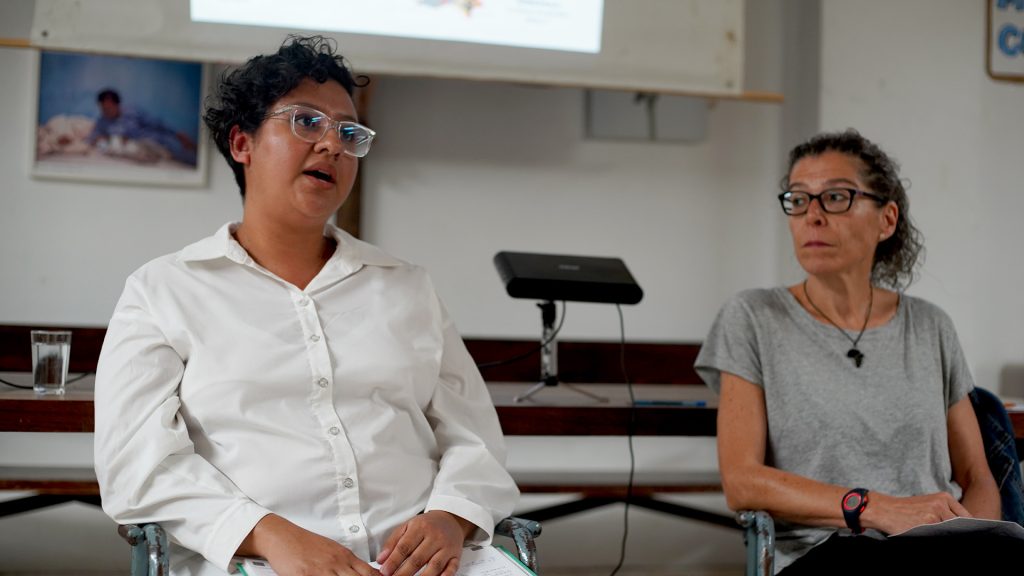
”In the meantime, the organisations will continue to accompany people in detention and, above all, we will not take our finger out of the wound on the torturous conditions that persist in detention centres.
Yuriria Salvador
Advocacy Coordinator of the Fray Matías de Córdova HRC