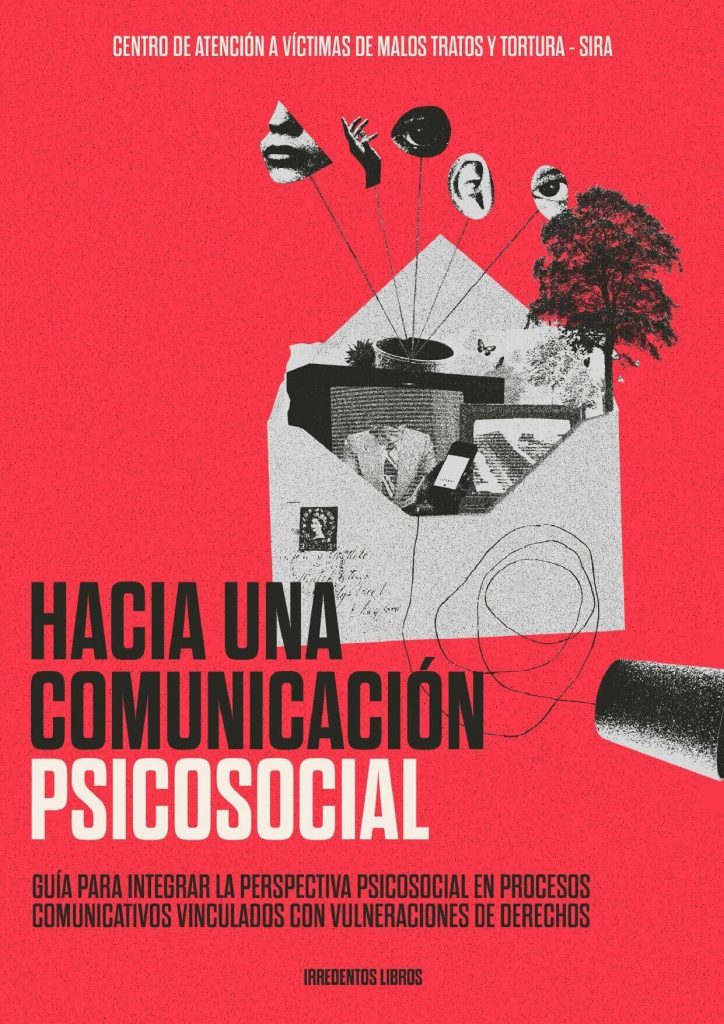
The guide «Towards psychosocial communication» is aimed at communication professionals, activists and social movements working in contexts of human rights violations and psychosocial trauma.
Among other actions, the manual aims to provide some keys for conducting interviews with a psychosocial approach, promoting safer and more respectful interventions.
The handbook Towards psychosocial communication: A guide to integrating a psychosocial perspective in communication processes related to rights violations arises from two main axes. On the one hand, the debates and reflections that, over the last few years, have taken place among the members of the Sira Centre; and on the other hand, various discussions that have originated in journalistic editorial offices, academic spaces and social and political organisations, particularly in contexts of political violence.
In an increasingly globalised world, our way of consuming and producing information has experienced major transformations. From traditional media such as television, radio and print, to social media and audiovisual platforms, communication channels have changed the way we relate to information. This avalanche of media representations profoundly influences the way we understand the world, how we position ourselves in it, and how we perceive others. These representations can generate significant impacts, not only when receiving information, but also when producing it.
Towards psychosocial communication is aimed at communication professionals, activists and social movements working in contexts of human rights violations and psychosocial trauma. Its aim is to make visible the impact of communication processes in these situations, offering practical tools both for those who produce content and for the individuals or groups who receive it, either directly or indirectly.
Illustration Towards psychosocial communication: A guide to integrating a psychosocial perspective in communication processes related to rights violations
A tool for communicating and interviewing with a psychosocial focus
In order to develop the guide, a process of literature review The Sira Centre also incorporated materials previously produced by the Sira Centre and the Sira Centre itself, as well as those produced by the Sira Centre itself and the Sira Centre itself. This process also incorporated materials previously developed by the Sira Centre itself and the Community Action Group. Among other things, expert documents were analysed, and communication products produced by these entities, such as the podcast “Gaps - Stories to accompany”.”, The cultural, social and communicative impacts play a central role.
In order to be able to contrast the information collected, incorporate new learning and adopt a respectful and collaborative approach, the 3 focus groups and in-depth interviews were organised.. These included the participation of activists, communication, advocacy and third sector professionals, as well as people who have participated in communication processes after having experienced human rights violations in the context of their political activism, their socio-economic vulnerability or for reasons of gender and/or racialisation.
The result of a collaborative process
The act of communicating always generates repercussions. Therefore, in contexts of rights violations and psychosocial trauma, it is essential to adopt a specific approach to understand and address the effects linked to mental health work. The media representations can increase the impact of the experience on survivors of human rights violations. If not dealt with in a dignified and responsible manner, public exposure can generate revictimisation, secondary victimisation, shame, humiliation and deterioration of identity, among others.
Integrating a psychosocial perspective into communication is therefore essential to ensure that information processes and representations do not aggravate the situation of those who are already vulnerable.
Why a guide on psychosocial communication?
Over the years, the incorporation of the psychosocial perspective has permeated various fields, such as legal, social and health care and project development. However, since the Sira Centre, We questioned whether this integration was being adequately carried out in communication processes, especially in complex contexts such as coverage of conflicts, migratory transit, natural disasters, social movements or even when biased representations of vulnerable groups are presented in the media.
This guide is intended as a tool so that those who, through their work, activism or militancy, intervene in communication processes can integrate these social psychology practices at different stages. For example, before starting an interview, during the course of the interview or even once the product has been published. At the same time, this manual offers analysis and protection strategies for all those involved.
The guide has been conceived as an exercise in giving back to the people that Sira, as a Centre for Attention to Victims of Vulnerations, has accompanied over the years. It is also presented as a synthesis of the reflections and contributions generated in this field, especially by and for those who struggle to dispute communication. from the margins.
Towards psychosocial communication: A guide to integrating a psychosocial perspective in communication processes related to rights violations
Centre for the Care of Victims of Abuse and Torture, Sira