
Two years after the entry into force of the Law of Democratic Memory, impunity and the lack of decisive action to clarify the truth about the serious crimes committed during Franco's regime are the major black spots of this law.
In these years, progress has been made, albeit very slowly, in aspects such as the promotion of the Public Prosecutor's Office for Democratic Memory, the creation of technical commissions on economic reparation for victims and the study of human rights violations between 78 and 83, the annulment of sentences handed down in unfair trials, and the exhumation work in the Valley of Cuelgamuros.
Today, 21 October, marks the second anniversary of the entry into force of the Democratic Memory Law (LMD). Amnesty International, CEAQUA, Iridia and Sira confirm what they had already warned about during the processing of the law: this law does not remove the obstacles to the judicial investigation of the crimes of Franco's regime, nor to the clarification of the serious human rights violations committed during that period. This is reiterated in Constitutional Court Order 57/2024 of 17 June, which states that the law does not authorise the investigation of the crimes of Franco's regime, nor does international law oblige Spain to do so.
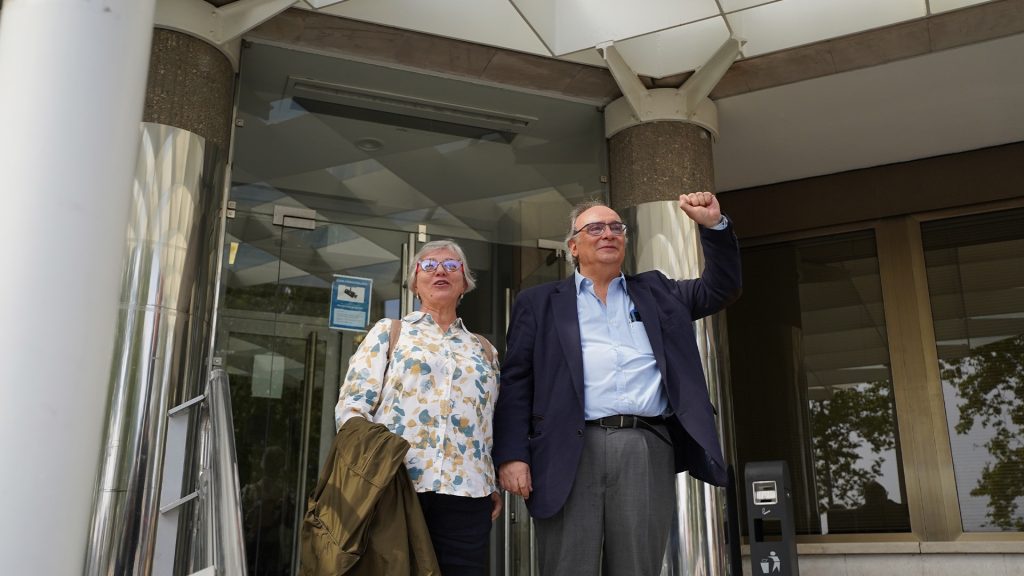
Julio Pacheco and Rosa García on leaving the Courts, after giving their statements. Sira Centre
Slow progress
Beyond the absence of accountability for past human rights violations, these two years have seen some progress in the area of democratic memory, such as the annulment of a judgment in unfair proceedings which is being reflected in court records, as in the case of some death sentences handed down between 1974 and 1975.
Also positive is the creation of the Office of the Prosecutor for Democratic Memory and Human Rights, which has taken a position in favour of promoting the criminal investigation of serious violations of International Human Rights Law or International Humanitarian Law that occurred during the timeframe of the LMD. However, despite this position and support, it has not initiated any criminal action before the courts to guarantee the right to effective judicial protection of the people who suffered these serious human rights violations.
On the other hand, the implementation of the law is being carried out with worrying slowness, as evidenced by the lack of regulatory development, The establishment of three technical commissions provided for in the law came a year and a half after its entry into force. Specifically, last April, the creation of three memory commissions was promoted, which, among other aspects, will evaluate which victims who have not yet received compensation will be entitled to it; they will study human rights violations between 1978 and 1983; and they will draw up a report on the measures necessary for the application of the principles of truth, justice, reparation and non-repetition with respect to the historical situation of the Roma people. To date, we have no news that these commissions have begun to function, nor how they are going to do so.
Finally, although the state appears to be taking an active role in leading the exhumations In the Cuelgamuros Valley, the general model continues to delegate this work to a large extent to civil society organisations, memory associations and some university projects, which have been carrying out this type of action for decades.
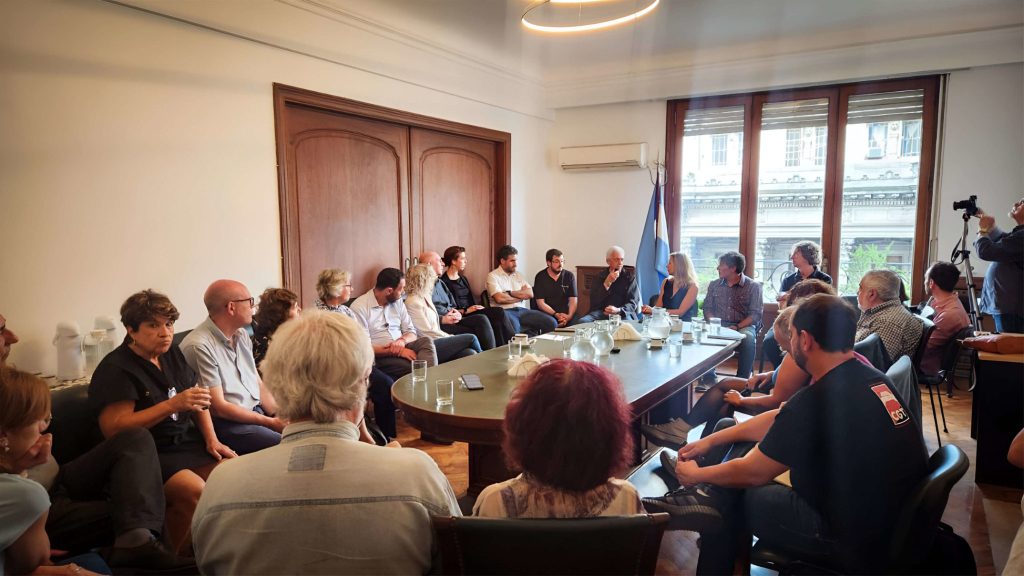
Complainants against Francoism meet with deputies in Buenos Aires. Ceaqua
Denial of justice
In recent years, there have been more than 100 complaints of torture, forced disappearance, extrajudicial executions, baby stealing and slave labour, by both individual complainants and local corporations. More than a dozen of these complaints have been filed since the entry into force of the Law of Democratic Memory. All of them have been inadmissible or shelved.
The Constitutional Court, in the Order of 17 June, considers that the articles of the current law The Law of Democratic Memory is insufficient and does not allow for the investigation of Franco's crimes.. Furthermore, as it did in the Order of 15 September 2021, it argues that at the time the crimes that are the subject of the complaint were committed, the Spanish Criminal Code did not contain a crime against humanity, adding that international law cannot be used as a source of criminal offences either, as this would be incompatible with the principle of criminal legality. It also considers that these crimes cannot be investigated as “ordinary” crimes as they are time-barred and amnestied.
The Constitutional Court ignores that international law establishes that the absence of codification by a State of crimes under international law at the time they were committed does not obviate the obligation to investigate them, and that such an investigation cannot be prevented by internal rules of States.
Since 2008, different mechanisms of United Nations have recommended in up to eleven reports that Spain adopt concrete and effective measures to put an end to impunity for the crimes of the Civil War and Francoism, depriving the 1977 Amnesty Law of its effects so that it cannot be applied by Spanish courts to prevent the prosecution of these crimes.
From the organisations we will continue to work to end impunity and the lack of investigation of the crimes committed during Franco's regime, we will continue to demand criminal justice and we will continue to file lawsuits until the victims of Franco obtain justice. For this, it is essential that the Spanish Parliament amends the 1977 Amnesty Law, and reforms the Penal Code to incorporate the principle of legality from an international law perspective.
Setbacks at the regional level
On this anniversary, we do not want to forget that in recent months some autonomous communities have been promoting laws that repeal or replace previously approved regional memory laws, negatively impacting the rights of the victims of Francoism. Examples of this are the repeal of the Law of Democratic Memory in Aragón, the proposals for repeal in the Balearic Islands, Cantabria and Extremadura, or the replacement of an autonomous LMD by a Law of Concord in the Valencian Community. These initiatives appear to be an attempt to make invisible the serious human rights violations committed during Franco's regime with measures such as the suspension of the victims' census, the closure of places of memory, or the exclusion of civil society organisations from the search and exhumation processes that these organisations have been promoting for decades.
Recommendations to the authorities
Therefore, we would like to remind you that it is absolutely necessary that:
- Parliament to promote appropriate legislative measures to reverse impunity for Franco's crimes, such as the modification/derogation of the Amnesty Law 1977 to ensure that it is not an obstacle to the investigation of the serious human rights violations committed during Franco's regime. In addition, the Penal Code should be reformed to incorporate the principle of legality with an international law perspective, and to bring the definitions of the crimes of torture and enforced disappearance in line with international conventions. In addition, the Stolen Babies Act The processing of which has declined in recent legislatures.
- The central government should initiate the regulatory development of the Law of Democratic Memory and carry out an effective and prompt implementation of the measures envisaged in this law in the whole of Spain. And fulfil its obligation to guarantee the preservation of the historical and collective memory of the human rights violations committed during Franco's regime and the Civil War.
- The autonomous communities that have approved or are in the process of approving new regulations on memory guarantee the historical preservation of the collective memory of the serious human rights violations committed in Spain during the Civil War and Franco's regime, and allow the entities that have traditionally worked for the victims to maintain their consultative role and develop their scope of action without undue limitations or restrictions.