
We analyse how migration policies affect mental health and why there is a need for situated psychologies that open up new approaches and perspectives.
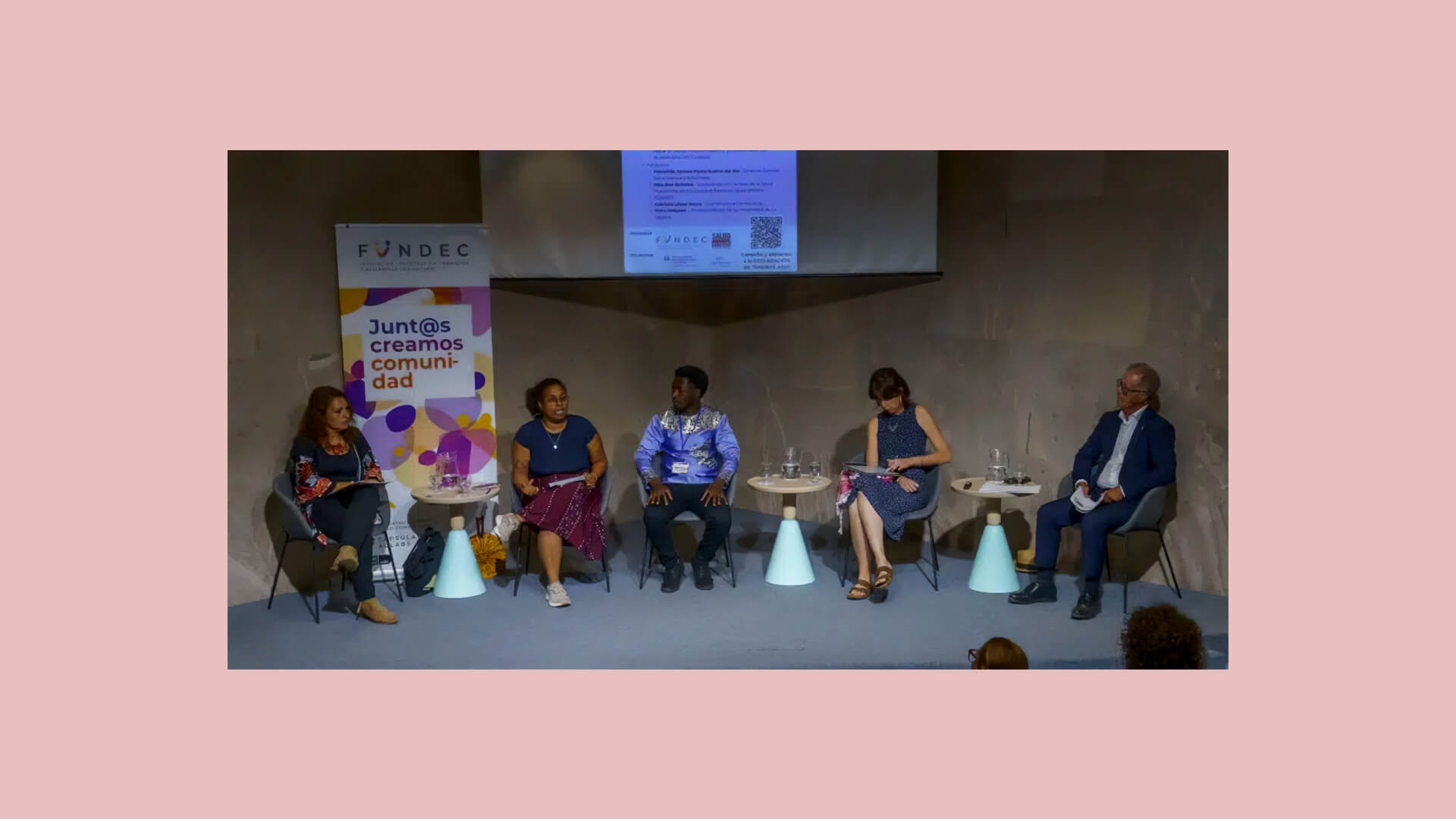
On 23 June last, we took part in Tenerife in the “Migration policy and health equity. New perspectives”organised by FUNDEC. Experts from the political, technical and academic spheres generated a space for rigorous, critical and innovative dialogue on the impacts of migration policies on the lives and health of migrants.
During the sessions, key concepts for understanding these impacts were recovered. They discussed the necropolitics, The concept, coined by the philosopher Achille Mbembe, and the idea of Europe in chains, by political scientist Samir Naïr. Both notions highlight the responsibility of European migration policy in the life and death of those who migrate: a system that, continuing colonial dynamics and driven by economic hierarchies, discriminates who can live and who is left to die.
Among the speakers was also the political scientist Sani Ladan. During his intervention, he explored through emotion, face and literature, how difficult it is to recognise suffering, fragility or psychic impact, in an environment where words never seem to be enough and where there is a demand to prove that pain and trauma are real. A context that normalises different scales of suffering according to the bodies that suffer it and the places they come from.
Is there a diagnosis for grief caused by bereavement, disappearance or uncertainty?
The bodies of many migrants, especially black bodies, carry countless wounds after crossing routes marked by violence. Migrant mourning is aggravated by situations of death and disappearance that may occur during transit, as well as by the impossibility of returning to the country of origin due to significant family losses. Added to all this is the need to rebuild a life project in a context that rarely facilitates it.
Mental health is the right to balance, projection and identity building. It is essential to be aware of how migration and immigration policies provoke repeated attacks on dignity, control and security, affecting the mental health of migrants. In mental health, our intervention should be aimed at reinforcing movements and spaces of support and resistance in the face of alienating or violent contexts, and accompanying people in the complex task of identity reformulation that migration requires.
In this framework, it is essential to recognise that hegemonic psychology limits our ability to understand the subjective impacts of migration. It is up to us to decolonise ourselves: to recognise that our intervention is also influenced by a history of colonisation and to turn to situated psychologies that offer new approaches and perspectives. To transform accompaniment into an exercise in reparation and change, both individually and collectively.
Towards a collective and transformative engagement
In addition to analysing the impacts, during the day the usual interpretation of interculturality was questioned, underlining that anti-racism is key to generating real change. The difficulty of talking about racism, and even more about institutional racism, was made visible, as well as the risk that hegemonic of what is not said, The European Union has been a very successful example of this, but it does not hide everything under the discourse, or the semantic universe, of interculturality.
The roundtables highlighted the importance of connecting worlds: returning to civil society the knowledge generated in the academy and awakening the academy from contact with social reality. It was recalled that politics and health are connected: politics makes people ill when it generates vulnerability, discrimination and violence.
Based on these reflections, we reaffirm our commitment to continue weaving from scientific and academic rigour, starting from violence and social realities, to give voice to those who suffer them, as an exercise of individual and collective reparation and transformation.